Day 2: The Posture
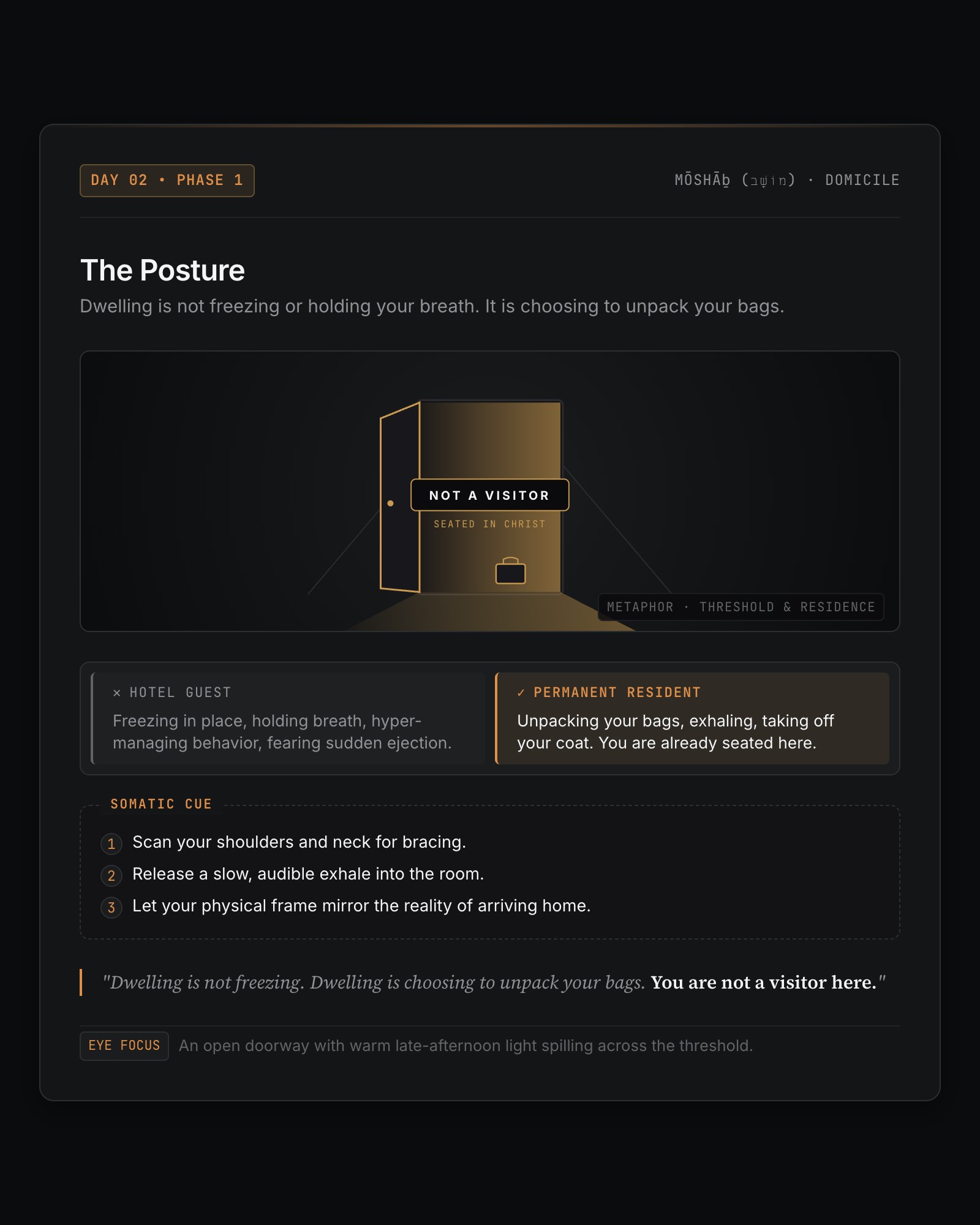
Day 2 Infographic
The 5-Minute Read
We often misunderstand what's actually required of us when we step into a spiritual space. Like you may have found, I have often thought I should go all intense about it — holding my breath to stay spiritual, carefully managing my behaviour so I wouldn't step out of bounds. We treat our relationship with YHWH like are staying at a hotel: you walk into the room, but your bag stays packed. You sit on the edge of the chair. You keep your coat on, hyper-aware of the rules, bracing for the moment you might be asked to leave. It takes a tremendous amount of energy to settle into *home* — and that careful, managed existence is not dwelling. It's just another form of exhaustion disguised as reverence.
Dwelling is not freezing. It is choosing to unpack your bags. Think about the difference between sitting in a hotel room and walking into your own living room. In your own home, you take your coat off. You exhale. You sit differently. You don't hold your breath to make sure you belong. The secret place is not a probationary space where your behaviour is constantly evaluated. It's a posture of settling in, of deciding with absolute finality:
“this is where I live now.”
You are not a visitor passing through. You, in Christ,are already seated there. Abiding does not describe a transient emotional state — it describes permanent residence. When you recognise that the secret place is your true home, the need for performance drops away. You don't have to manage the way that you sit to make sure you won't be asked to leave, because...
“the space belongs to you.”
As you attempt to relax into this posture, you'll likely feel a spike of resistance. The old tension within you doesn't want to unpack its bags — it feels safer to stay on edge, hyper-vigilant, ready to defend your place. You may feel an involuntary tightening in your chest when you try to let your guard down, or a voice insisting that if you stop managing your spiritual performance, you'll lose your standing. Let it say what it wants to say. Don't fight the feeling of vulnerability, and don't rush to fix it. The friction is simply the sensation of old coping mechanisms starving for oxygen. Let them starve. You don't have to obey the anxiety to stay here.
5-Minute Practice
Find a seat where you can settle for five minutes. Set a timer if that helps keep the clock out of your head.
Think about the difference between sitting in a hotel room and sitting in your own living room. In a hotel room, your bag stays packed. You're visiting, passing through. But when you walk into your own home, you take your coat off. You exhale. You sit differently. Today, I want you to physically practice the posture of someone who lives here, not someone who's just passing through.
Sit somewhere you can let your full weight settle — feet flat, spine supported, hands open on your lap, palms up. Let your shoulders drop away from your ears. Take one slow breath in, and let it go slower than it came.
Notice the posture of your own body right now. Are your shoulders tight? Are you bracing for the day, quietly preparing for a threat that isn't in the room? Exhale, and let your physical frame mirror the spiritual reality of dwelling. Take the coat off. Allow yourself to relax into the space exactly the way you would in a room that belongs to you. If a thought comes — a task, a worry, an old habit of bracing — don't fight it and don't scold yourself for it. Just notice it, let it pass through, and settle your shoulders again. This isn't a one-time unpacking — you may re-pack your bags twenty times before lunch tomorrow, out of habit. Each time you notice it, just unpack again. You are not a visitor here. You are a resident. You can stay as long as you want.
Let your eyes open whenever you're ready.
Tomorrow we will look at the location of this secret place. Come back when you're ready.
Chapter Companion Fieldwork Guide
PDF Reference • 2.4 MB • Printable Journal